Industrial Operator by Cleverdist
Product
  • Protect Dispatch Window
  • Recover Line Speed
  • Catch Transfer Losses
  • Keep Cranes Moving
  • Prevent HVAC Recovery
  • Clear Weak Assets
PricingQ&AAbout
info@cleverdist.com

Industrial Operator

Autonomous AI for industrial operations.

Supervised or Autonomous
On top of existing systems
Built-in governance

IO in the real world

References

Supporting multi-plant combined-cycle operations with IO
Naturgy logo

Naturgy + IO

Supporting multi-plant combined-cycle operations with IO

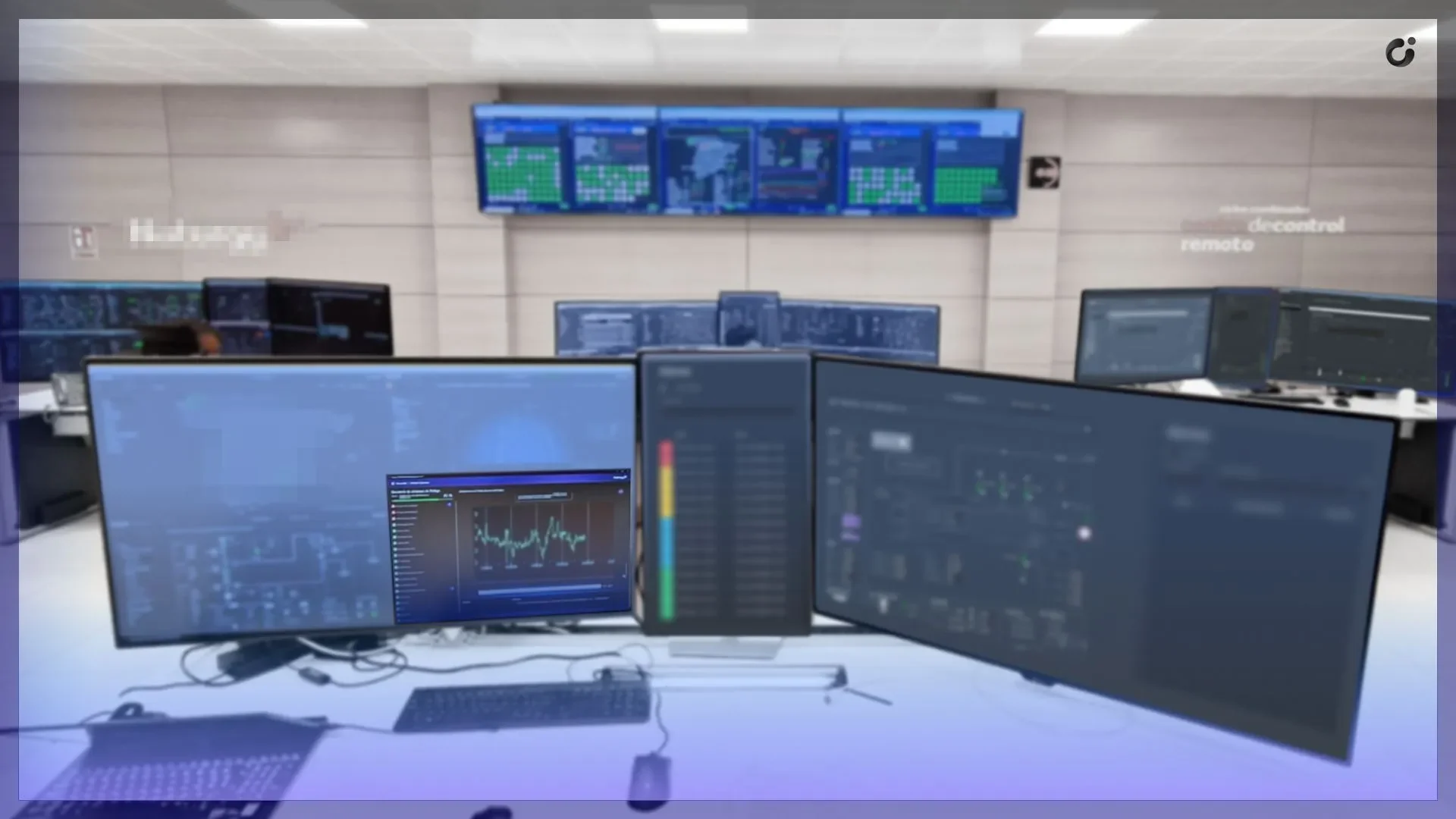
Centralized operations across combined-cycle power plants, with IO reasoning above existing plant systems.

11combined-cycle sites
17gas turbine units
10-25%hidden capacity identified
+5-15%throughput gain potential
€1.3Min avoided investment
€700k-€1Mannual value potential
10M+I/O parameters
50+More than 50-country collaboration
AllMultilingual shifter support
70%up to 70% fewer expert escalations

Deployed in real industrial environments — not demos. Built on 10+ years of mission-critical automation expertise.

Swiss-tech
Industrial-grade engineering
Vendor-agnostic

Differentiation

We model thinking,
not tasks.

Others chain AI agents in workflows. IO captures how your experts actually reason. That's why it scales where others don't.

Others: Linear Workflow
IO: Industrial Reasoning
STEP 01STEP 02STEP 03
Read our technical approach (PDF)

Governance & Accountability

Your pace. Your policies.

Governance that scales with confidence. Some teams need human-in-the-loop today. Others are ready for delegated execution. IO supports both, with explicit policies, full audit trails, and the flexibility to evolve at your pace.
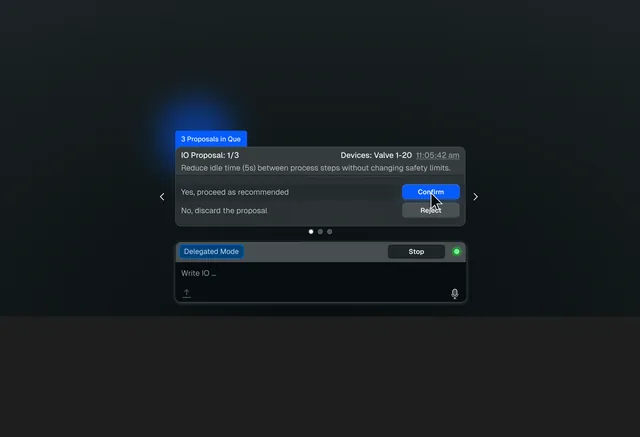
IO proposal queue — human confirms or rejects each recommendation before execution

Human in the loop

AI thinks. You decide.

Full visibility at all times. IO surfaces recommendations — every action requires a human to approve before anything happens.
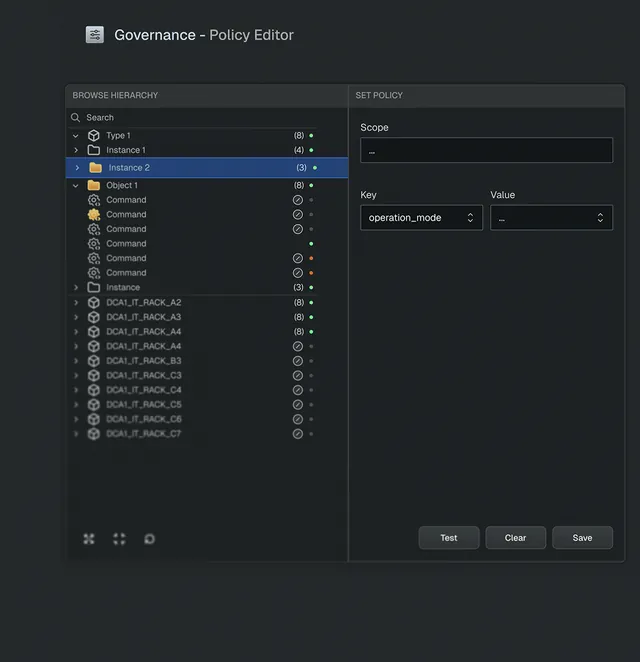
Governance policy editor — browse hierarchy and set scoped policies for delegated execution

Delegated Execution

AI acts within your rules.

Delegation is explicit, scoped, and reversible. You define what IO may or may not do — and responsibility always remains human-owned.

  • AI cannot decide or act
  • Every action remains human-validated
  • Full audit trail for regulators
  • Delegation is explicit, scoped, reversible
  • Your rules define what AI may or may not do
  • Responsibility remains human-owned

Architecture

The journey with us is simple.

We model your landscape.

Messy is fine. Our onboarding tools create the context (ontology) AI needs. We work directly with you or with your trusted integrators.

Seamless integration across your ecosystem

SCADA / DCS
Historians
MES
ERP
EAM / CMMS
APM
Quality / LIMS
Planning / APS
Documents
APIs

Examples include

SiemensWinCC OAIgnitionAVEVAABB 800xADeltaVHoneywell ExperionYokogawa CENTUM VPFactoryTalkGE ProficyPI SystemSAPIBM MaximoServiceNow...and more
Download IO Secure Architecture (PDF)

Ready?

Start your pilot.

One mission. Clear success metric. Governed rollout.

Book an intro
IOby Cleverdist

Autonomous AI that operates within your governance, at any scale.

info@cleverdist.comLinkedIn

Product

Company

AboutQ&AContact

Legal

© 2026 Cleverdist SA · Geneva, Switzerland

Use Alt with the left or right arrow keys to move to the previous or next use case in the carousel.

IO Use Cases

Energy

Protect Dispatch Window

Manufacturing

Recover Line Speed

Logistics

Catch Transfer LossesKeep Cranes Moving

Mobility

Prevent HVAC RecoveryClear Weak Assets

Food & Beverage Manufacturing

Recover lost line throughput while staying inside quality limits

IO captures expert quality reasoning and applies it continuously to line speed, changeovers and process conditions, so production can move closer to design throughput without taking uncontrolled quality risk.

Relevant for high-volume lines where actual throughput stays below design throughput because teams keep conservative speed or process settings to ensure quality.

5-15%recoverable throughput gap
10-30%fewer recurring quality excursions
Multi-linebest fit for scaled expert reasoning
€300k-2Mindicative annual value range

SEO slug: industrial-ai-agents-food-beverage-line-throughput-quality-control

Use-case summary: Digitalize the judgement of operations and quality experts, then apply it across lines, shifts and operating states.

Use case context

The line can produce more, but quality risk keeps actual throughput below design throughput

Food and beverage lines often operate below design throughput without being formally down. The line is producing, but speed, parameters or operating windows remain conservative.

This can be the correct decision. A quality incident has immediate cost, so operators keep margin when the current line state is not fully trusted.

In many cases, reducing speed becomes the default quality lever, even when experts know that another action could address the risk with less throughput loss.

The expert knowledge usually exists: quality and operations specialists know which symptoms, limits, changeover states and process conditions matter. The problem is that this reasoning is not applied consistently across every line, shift and decision point.

IO turns that expert reasoning into a mission: read the line state, compare it with known quality-risk patterns, recommend the next safe action and record the decision.

Concrete trigger

A recurring quality issue leads a shift team to lower speed or keep conservative parameters. The cause may be a specific changeover state, underperforming component, unavailable process lever or alignment condition, but that reasoning is not applied consistently across shifts and lines.

Pain points

What the plant loses when quality judgement is not applied continuously

The issue is not only downtime or OEE reporting. The machine may be producing, while the gap between design throughput and actual throughput becomes normalized in daily operation.

Design vs actual throughput gap

  • The line is capable of a higher proven rate.
  • Actual throughput remains lower during normal production.
  • The gap becomes accepted as the operating baseline.

Conservative quality settings

  • Teams keep speed or parameters inside a wider safety margin.
  • The cost of a quality excursion is visible and immediate.
  • The cost of conservative production accumulates more quietly.

Expert knowledge bottleneck

  • The right judgement may depend on a few experts.
  • Different shifts apply different levels of caution.
  • Rules are often discussed, not operationalized 24/7.

Maintenance priority blind spots

  • A degraded component may force conservative operation.
  • A missing process lever may limit safe speed recovery.
  • The issue may not be prioritized because the line still produces.

How IO reasons

IO models the expert judgement behind safe throughput recovery

This mission is not simple defect counting. IO applies the reasoning that quality and operations experts use when deciding whether to increase speed, hold the current state, change parameters or escalate a line condition.

Models quality-limit reasoning

Captures what experts check before moving closer to the limit: defect type, product, speed, process parameters, inspection history, line state and recent changes.

Selects the right quality lever

When lower speed is only one way to stay inside quality limits, IO can recommend other expert-approved levers first: parameter tuning, stabilization actions, extra inspection, material checks or maintenance escalation.

Connects performance to line state

Reads changeovers, stabilization phases, alarms, sanitation or cleaning states, material changes and process variables as part of the same decision context.

Escalates maintenance constraints

Identifies when throughput or quality is constrained by misalignment, unavailable actuators, degraded parts or underperforming equipment that should become a maintenance priority.

IO governance

The user decides how much authority IO has

IO analyzes the current line state, quality signals, process conditions and expert rules. Depending on the configured operating mode, IO either proposes an action for user confirmation or executes an authorized action directly under defined policies.

Supervised mode: IO proposes, the user confirms

  • IO proposes the least disruptive expert-approved lever for the current line state.
  • IO explains why that action fits the quality risk, process condition and available signals.
  • The user approves, rejects or corrects the recommendation before anything changes.
  • IO records the decision and uses corrections to improve future recommendations.

This is the natural starting point when quality risk, process stability and operational responsibility must remain explicitly controlled.

Delegated mode: IO executes only inside authorized policies

  • The user defines which actions IO may execute directly.
  • The user defines the line, product, shift or process conditions where delegation applies.
  • The user defines thresholds that still require confirmation.
  • IO escalates whenever the situation leaves the authorized policy.
Example policies
  • Adjust speed within an approved band when quality risk remains low.
  • Trigger an extra quality check after a risky changeover.
  • Escalate maintenance when a degraded component constrains quality or throughput.
  • Keep line stops, batch release or high-risk actions supervised unless explicitly authorized.

Expected benefits

More sellable output from the same assets, while keeping product quality consistent

Expected value depends on line volume, the current design-vs-actual gap, defect sensitivity, and how consistently expert reasoning can be applied across shifts and line states.

Higher actual throughput

Move closer to design throughput when the expert reasoning shows quality risk is controlled.

Fewer quality excursions

Apply the same expert checks before increasing speed or changing parameters, across shifts and line states.

More confident decisions

Give operators and managers a traceable reason for holding, pushing, checking or escalating.

Better maintenance focus

Surface line conditions that limit safe performance, even when the line is not fully stopped.

Discuss this case

Your line has higher design throughput. What if expert reasoning could be applied every shift, 24/7?

The first step is to frame the mission: where performance is being left on the table, which expert decisions matter, which signals are available, and which actions should remain supervised or become delegated over time.

  • Where is actual throughput consistently below the line's proven capability?
  • Which quality decisions are currently made by experienced operators or process experts?
  • Which signals are already available to support those decisions?
  • Which operational levers could IO recommend, prepare or execute under supervision?
  • Which benefits would make the mission worth validating?

Want to map this to your line data or operating rules?

info@cleverdist.comLinkedIn